When Is Robotic Welding Economically Justified: 5 Signs Your Production Is Ready for Automation
Robotic welding is not a universal solution for every manufacturing operation. It creates the highest value when there are clear prerequisites: repeatable operations, sufficient volume, shortage of skilled welders, inconsistent quality, or a need for better production predictability. That is why the right question is not “Should we buy a robot?”, but “Do we have a process where automation will solve a real production problem?”.
The global trend is clear: according to the International Federation of Robotics, 542,000 industrial robots were installed in manufacturing in 2024, and annual installations exceeded 500,000 units for the fourth consecutive year. This shows that automation is no longer an isolated investment only for large corporations, but part of the competitive strategy of industrial enterprises.
1. You have repeatable welding operations and sufficient volume
The first and most important sign is repeatability. Robotic welding is most effective with parts that are produced repeatedly, with clearly defined welds, stable geometry, and a similar sequence of operations. Miller Welds notes that simple and repeatable parts with higher volume and lower complexity are usually very suitable for welding automation.
This does not mean that automation is only applicable to mass production. Modern solutions also allow work with smaller batches, but in such cases fast changeover, good fixtures, offline programming, and proper grouping of parts into “families” become critical.
Practical signs that you are close to being ready for automation:
- you have recurring products or welds;
- welding operations take up a significant part of the production cycle;
- parts can be fixed in a stable and repeatable way;
- manual welding time is predictable but limits capacity.
If every weld is completely different, every workpiece has major deviations, and every product requires individual judgment, the first step is not the robot, but process standardization.
2. Shortage of skilled welders is already affecting deadlines and capacity
The shortage of skilled welders is one of the strongest arguments for automation. The American Welding Society states that the United States alone will need 320,500 new welding professionals by 2029, with an average of around 80,000 positions needing to be filled each year between 2025 and 2029.
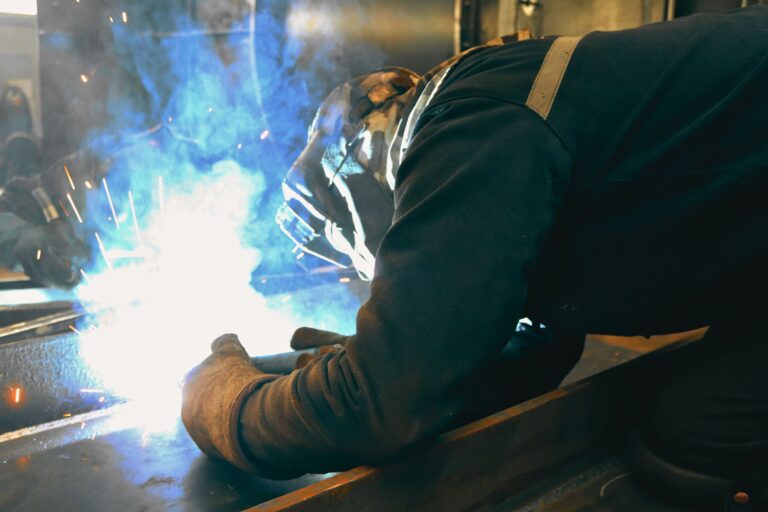
This is not only an American issue. In many industrial markets, companies face similar challenges: fewer young specialists, high dependence on experienced welders, difficult replacement during absences, and pressure on delivery deadlines. Robotization does not eliminate the need for people. It changes their role. Experienced welders can be involved in setup, control, process preparation, and solving more complex cases instead of performing the same repetitive welds every day.
This is especially important for companies where:
- production depends on a small number of key welders;
- the absence of one person delays order execution;
- quality varies depending on the shift or the specific operator;
- finding new qualified staff is difficult;
- experienced specialists are used for routine operations instead of higher-value tasks.
In this scenario, a robotic cell is not simply an investment in equipment, but a way to reduce workforce risk.
3. You have inconsistent quality, rework, or a high rate of deviations
One of the strongest arguments for robotic welding is repeatability. Lincoln Electric notes that combining robotics with welding operations can lead to improvements in quality, better repeatability, and faster production.
In manual welding, quality depends on skills, fatigue, working conditions, welding position, accessibility, and operator workload. In robotic welding, parameters and trajectories can be reproduced with high consistency. This does not automatically guarantee a good weld, but it enables a stable process if preparation, fixturing, WPS, and settings are properly developed.
Robotization may be economically justified when you have:
- recurring defects;
- significant rework volume;
- inconsistent weld appearance;
- quality differences between operators or shifts;
- difficulty achieving the same result in serial products;
- customer complaints related to consistency of execution.
In this case, return on investment does not come only from faster welding. It also comes from less rework, less wasted material, fewer delays, and lower risk of non-conformities reaching the customer.
4. Your customers require better traceability, documentation, and proof of process
For many manufacturing companies, quality is no longer proven only by the finished part. More often, customers expect documentation: applicable WPS, performer data, inspection records, test results, evidence of parameters, and process consistency. In the previous article, we explored exactly this point: traceability is not simply an archive, but a quality control mechanism.
Robotic systems support this logic because the process is more structured. When a cell is properly integrated, it can help collect data on welds, parameters, operation time, status, deviations, and inspection results. Fronius, for example, positions its welding data management solutions around planning, recording, analysis, and visualization of production data.
This is especially important for:
- products for industries with higher documentation requirements;
- customers that conduct regular audits;
- production of components with a critical function;
- the need to quickly prove how a specific weld was performed;
- internal programs for reducing defects and tracing root causes.
Robotization does not replace the quality system, but it can make it more reliable, more structured, and less dependent on manual records.
5. You are under pressure for shorter lead times, higher productivity, and better predictability
Manual welding is often a bottleneck in production. If orders are accumulating, lead times are increasing, and capacity depends on workforce availability, automation can have a strong impact. Doosan Robotics summarizes the main ROI factors in robotic welding as reduced scrap and rework, faster cycle time, longer uptime, and better labor management.
Here, the economic logic is broader than a direct comparison between “welder vs. robot.” The real question is how automation affects the entire flow:
- does it reduce order completion time;
- does it increase predictable capacity;
- does it reduce dependence on overtime;
- does it allow better planning;
- does it reduce blockage of other production stages;
- does it improve the ability to accept more orders.
If welding is a bottleneck, a robotic cell can affect not only the operation itself, but the entire production organization.
How to think about return on investment
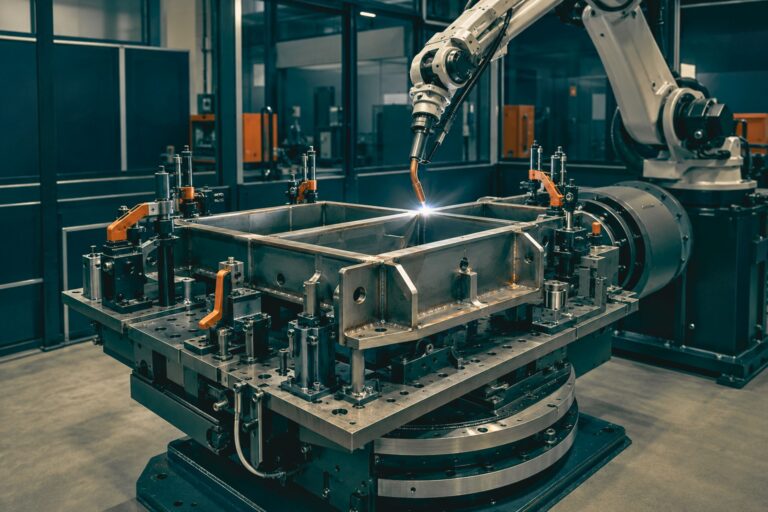
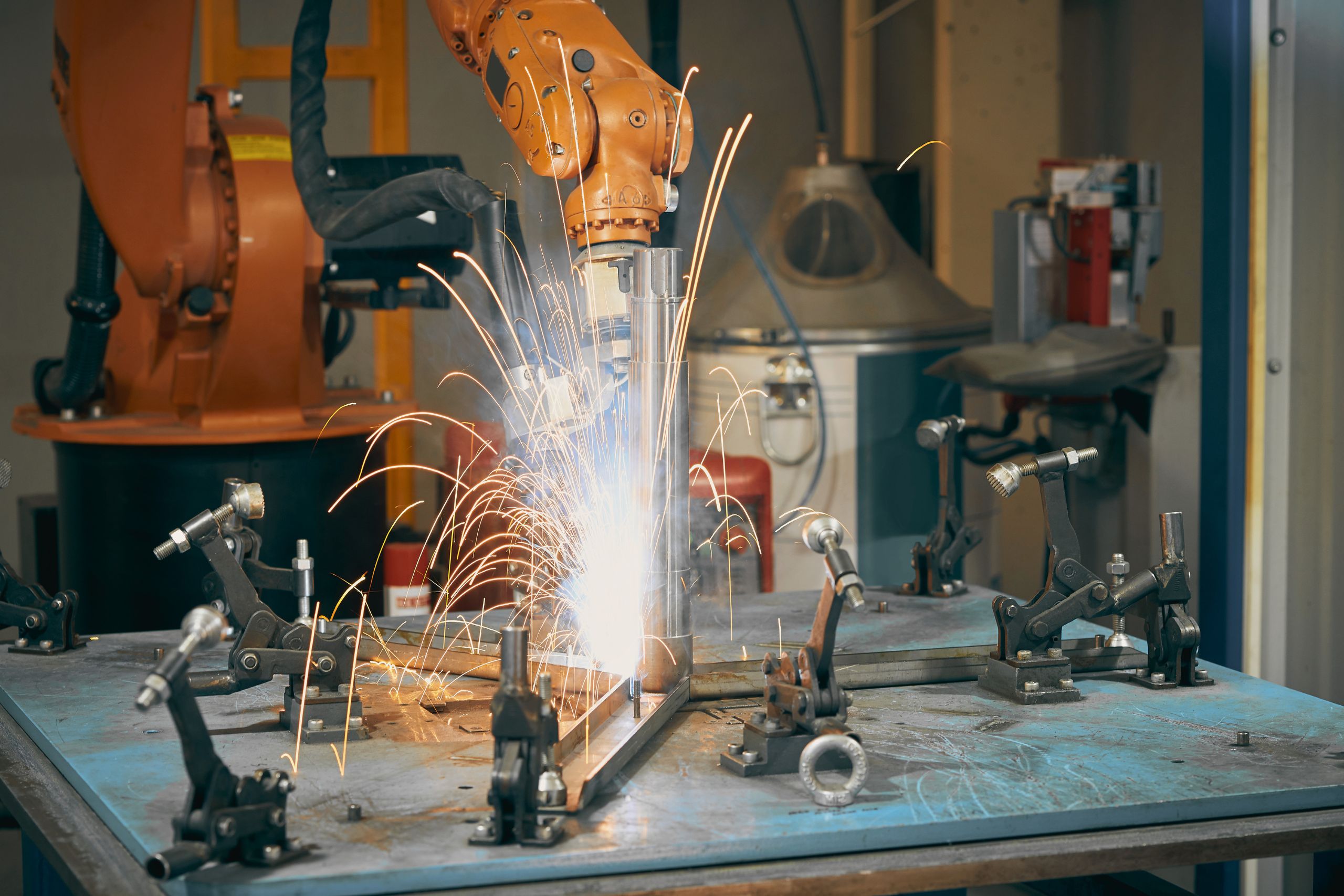
Economic justification should not be assessed only through the price of the robot. A robotic welding cell is a system: robot, power source, torch, wire feeder, positioner, fixtures, safety, programming, integration, training, and maintenance. That is why a proper evaluation should include both direct and indirect factors.
The main components of the analysis are:
1. Current costs of the manual operation
Welding time, preparation, rework, inspection, internal logistics, and downtime.
2. Expected cycle time with automation
Not only arc time, but the full cycle: loading, fixturing, welding, inspection, and unloading.
3. Costs related to non-conformities
Scrap, rework, delays, complaints, additional inspections, and lost time.
4. Workforce risk
Dependence on a limited number of specialists, difficulty of replacement, training, and turnover.
5. Potential for additional capacity
Ability to accept more orders, shorten lead times, or stabilize delivery.
Lincoln Electric emphasizes that automation is not only applicable to “big jobs,” but can deliver quality, repeatability, and productivity across a wider range of manufacturing operations when the application is properly selected.
When robotization is probably not the first step
It is also important to state the opposite: there are situations where robotic welding may be premature.
For example:
- parts do not have stable geometry;
- preparation and fit-up are too variable;
- there is not enough repeatability;
- clear WPS or standardized parameters are missing;
- fixtures are poorly developed;
- there is no team to maintain and manage the process;
- the expectation is that the robot will compensate for organizational problems.
In such cases, the better first step is a process review: standardizing parts, improving fixtures, clarifying WPS, analyzing defects, and assessing the real production flow. Automation can then be planned on a stable foundation.
Practical checklist: are you ready for robotic welding?
You can use the following questions as an initial self-assessment:
- Do we have repeatable products or welds?
- Can we fixture parts in a stable and repeatable way?
- Do we have sufficient volume or frequent repetition?
- Do we have a shortage of welders?
- Do we have rework, defects, or inconsistent quality?
- Do customers require more documentation and traceability?
- Is welding limiting our capacity or delivery deadlines?
- Do we have clear WPS and a process foundation?
- Can we group products into families?
- Are we ready to invest not only in a robot, but in a complete production cell?
If the answer to most of these questions is “yes,” it is probably worth conducting a more detailed robotic welding assessment.
Conclusion
Robotic welding is economically justified when it solves a specific production problem: insufficient capacity, inconsistent quality, high rework, workforce risk, weak traceability, or pressure for shorter lead times. The most successful projects do not start with purchasing equipment, but with an honest assessment of the process, parts, volume, quality, and production goals. When these factors are clearly defined, the robotic cell can become a sustainable production asset, not just a technology investment.
If you are considering robotic welding and want to assess whether your production is ready for automation, the Bullitt Robotics team can support you with feasibility analysis, concept development, and engineering assessment tailored to your parts, volumes, and production environment. Contact us at +359 89 667 0392 or at office@bullitt-engineering.com to discuss the most suitable approach for your production.
Sources used
- International Federation of Robotics, World Robotics 2025: data on global industrial robot installations. (IFR International Federation of Robotics)
- American Welding Society: data on the shortage and expected demand for new welding professionals by 2029. (American Welding Society)
- Miller Welds: criteria for suitable applications in welding automation. (millerwelds.com)
- Lincoln Electric: benefits of automated welding, including quality, repeatability, and productivity. (lincolnelectric.com)
- Doosan Robotics: ROI factors in robotic welding, including scrap, rework, cycle time, uptime, and labor management. (Doosan Robotics)