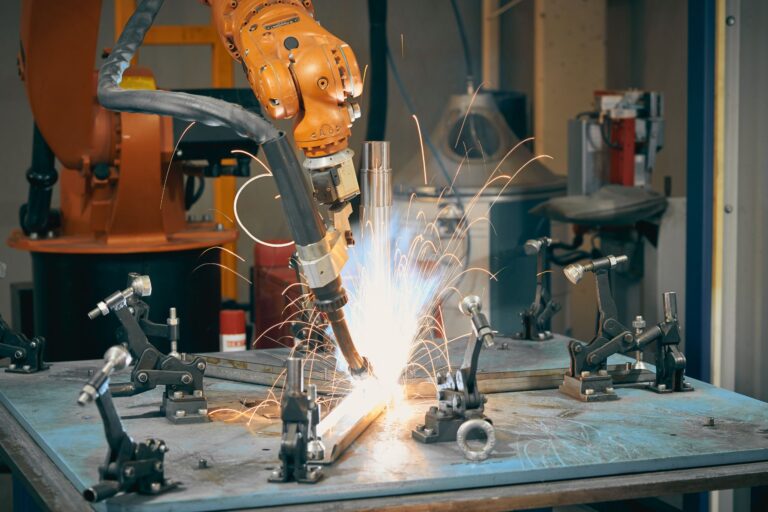
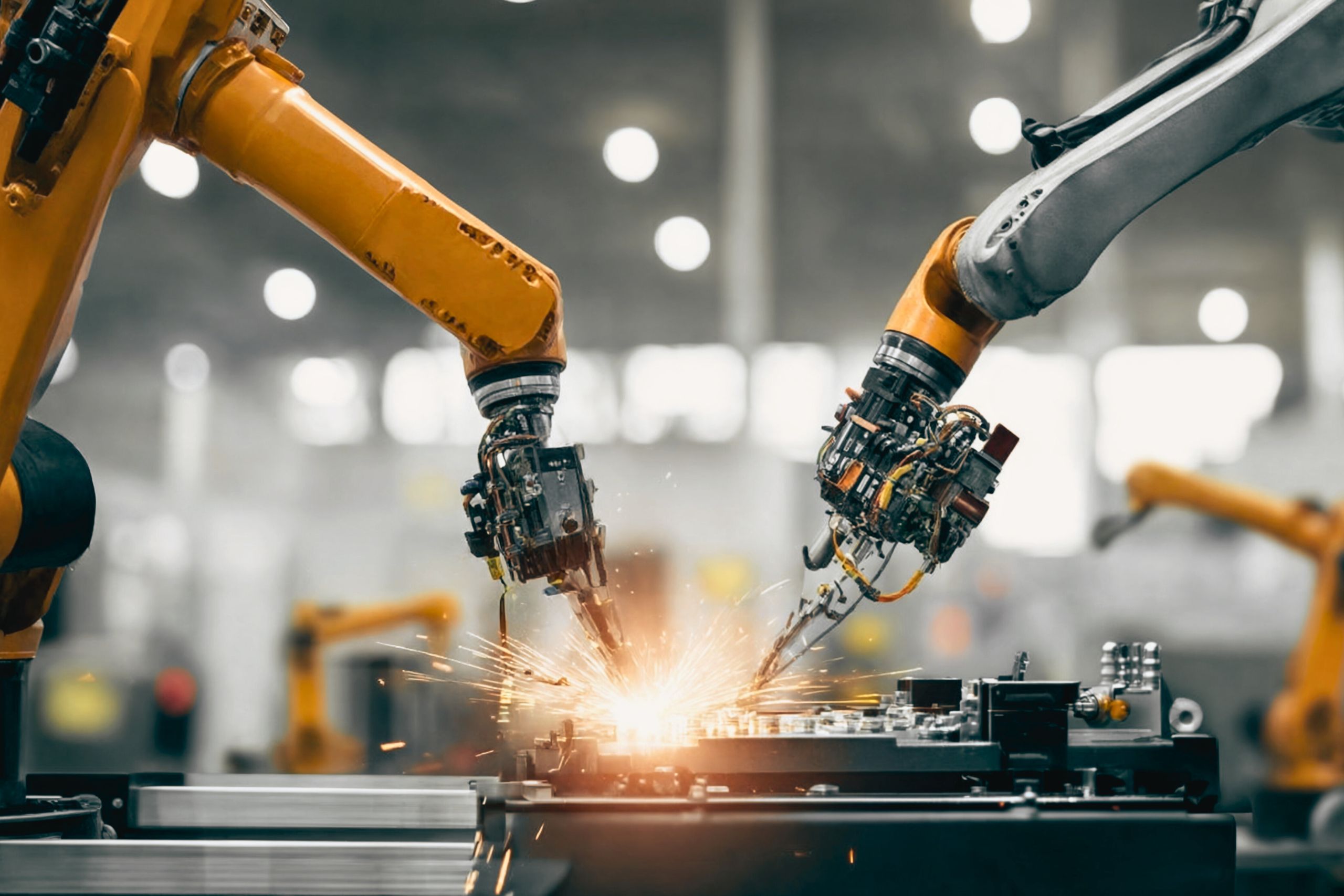
Robotic welding trends in 2026: from „robot in a cage“ to adaptive, connected and traceable production
The first publication of the year is a good opportunity to look at where robotic welding is actually headed. In 2026, the leading change is not „more robots“, but smarter welding cells: adaptive to part variations, integrated with production systems and with built-in process traceability, which allows for manageable quality and lower risk in serial and project production. These trends are visible both in the development of robotics as an industry and in specific technological solutions in welding. (IFR International Federation of Robotics)
1) Closed-loop control: the robot „corrects“ itself during welding
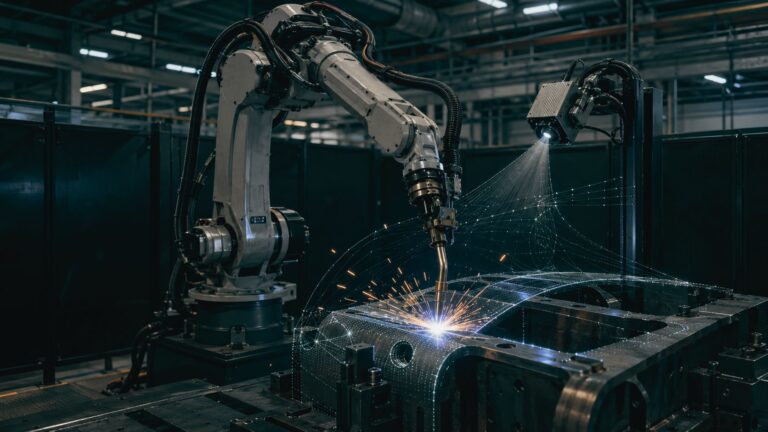
The most important leap in applications in 2026 is the massive adoption of closed loop: sensors and algorithms monitor the process and correct trajectory, parameters or positioning in real time. This is a direct answer to the classic problem in welding: fit-up deviations, deformations, workpiece tolerances and batch-to-batch variations.
- Thru-the-arc seam tracking (TAST): solutions such as ABB WeldGuide IV use the electrical characteristics of the arc and „guide“ the robot along the actual seam, including difficult details and variations. (ABB Group)
- Visual and laser systems: scientific reviews and new developments show accelerated progress in visual seam tracking and resistance to spatter, arc light and noise, including for curved and closed seams. (ScienceDirect)
Practical effect: fewer readjustments, fewer defects and more stable quality with "non-ideal" parts.
2) AI and multi-sensor in-process quality inspection
In 2026, AI is most successfully used not as „magic“ but as a tool for analyzing large volumes of process data and signals (video, acoustics, electrical parameters) for the purpose of early detection of defects and anomalies. AWS (Amazon Web Services) and IBM describe an approach for practical 100% weld monitoring through combined signals and near real-time insights, and AWS (American Welding Society) emphasizes the real limitations and the need for the right data and implementation at the production process level. (Amazon Web Services, Inc.)
Practical effect: shorter "detection → correction" cycle, less hidden defects and better risk control for critical products.
3) Traceability and digital documentation: welding becomes „auditable“
There is a growing demand for the client to receive not just a detail, but a demonstrable process: who, when, with what parameters, what deviations and what correction was applied. This is accelerated by pressure for quality, regulations, certification practices and supply chain requirements.
- Welding data management platforms such as the Fronius WeldCube are perfectly positioned for planning, recording, analyzing and visualizing production data. (Fronius)
- The trend is clear: traceability is shifting from a „paper protocol“ to structured, machine-readable data and reports that enable analysis and optimization.
Practical effect: faster acceptance procedures, lower risk of complaints and better quality management.
4) Integration with MES/ERP and industrial protocols: OPC UA as a „bridge“ to the digital factory
In 2026, the welding cell is seen as a data source and a controllable production module, rather than an isolated piece of equipment. Therefore, the importance of industry standards for connectivity is growing.
Fronius describes OPT/i OPC-UA as a standardized way to transmit a defined set of data (set/actual values, process information, system information) and even to feed certain parameters back to the system, which is key for traceability and integration. (Fronius)
Practical effect: easier integration with production systems, automated reports and a basis for predictive maintenance.
5) Updated safety standards: higher „cost of error“ but also clearer rules
With the rise of collaborative scenarios and more flexible cells, safety is becoming an even more central topic. ISO 10218-1:2025 and ISO 10218-2:2025 update the safety framework for industrial robots and robotic systems, and in the US, the R15.06-2025 standard is adapted from these ISO documents. (iso.org)
What this means in 2026: new deployments will look much more closely at risk assessment, protective features, fencing/scanning systems, and safety documentation.
6) Flexible automation for high mix and small batches: „less programming, more customizability“
The market pressure is for shorter lead times and a greater variety of products. In robotics, this manifests itself as trends towards easier implementation, more intuitive programming, and faster reconfiguration of systems and cells, also reported by the International Federation of Robotics (IFR) as part of the broader trends in robotics. (IFR International Federation of Robotics)
Practical effect: automation becomes applicable not only for long series, but also for project/niche production, provided that the cell is designed for fast changeovers and stable control.
7) „Smart“ welding sources and remote maintenance
Modern welding systems are positioning themselves as „Industry 4.0 ready“ through network connectivity and user/settings management, as well as remote diagnostics and data exchange capabilities. An example of this direction is Fronius’ product materials (iWave) with an emphasis on connectivity and digital data management. (Fronius)
Practical effect: fewer unplanned stops, faster response to problems, better control over the repeatability of settings.
8) What should manufacturing companies prioritize in 2026 (short checklist)
- Choose a „control strategy“: how you will compensate for fit-up and geometry deviations (TAST, laser/visual tracking, combination). (ABB Group)
- Design traceability into the concept: which parameters are critical, how they are collected, how they are stored, and how they are proven to the customer/audit. (Fronius)
- Plan integration into production systems: interfaces and protocols (e.g. OPC UA) and a minimum set of KPIs. (Fronius)
- Update your approach to safety according to current standards and best practices. (iso.org)
- Think of data as an asset: a prerequisite for optimization, AI analysis, and scrap reduction. (American Welding Society)
Conclusion
In 2026, competitive advantage in robotic welding will come from three factors: adaptability (sensors and closed loop), connectivity (integration and industry protocols), and provability (process traceability and accountability). Companies that plan deployments with a focus on these three areas will reduce manufacturing risk, increase repeatability, and shorten the time from setup to stable serial operation. (IFR International Federation of Robotics)
If you are planning a new robotic welding cell, upgrading an existing line, or looking to improve repeatability, quality, and traceability, the Bullitt Robotics team can assist you with a feasibility assessment, concept, and implementation tailored to your specific details and production environment. Contact us on +359 89 667 0392 or at office@bullitt-engineering.comto discuss your goals and the most appropriate approach for your production.